

You’re publishing weekly, the list is growing, and the Sunday block has crept from four hours to six. So you start thinking the obvious thought. Maybe it is time to hire someone. A writer. A virtual assistant. An intern to handle the formatting and the source scanning while you keep the parts that matter.
The instinct makes sense. It is also the move that costs you the most before it returns anything.
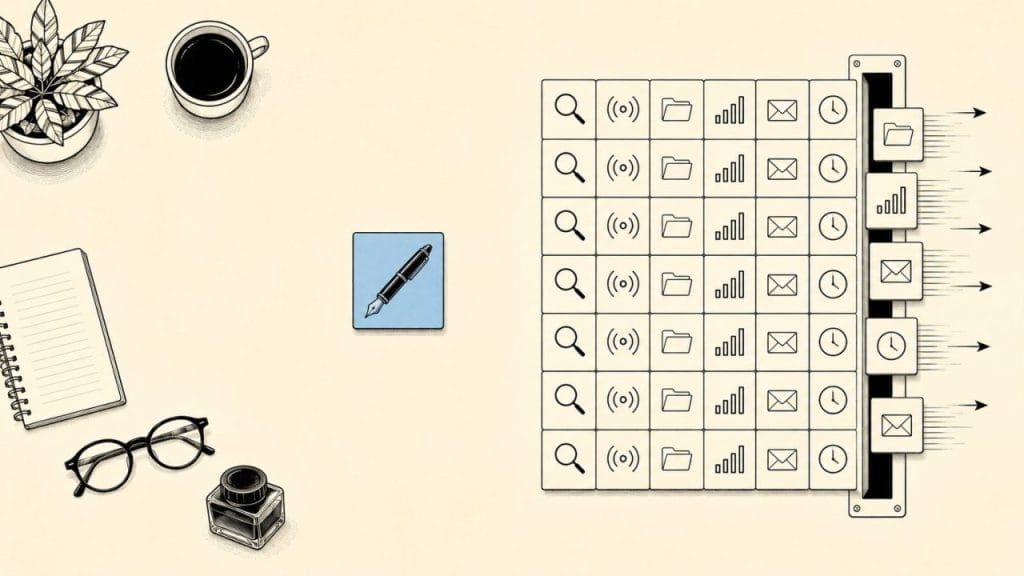
There is a way to automate your newsletter without hiring that gives you back hours this week, and it starts with a question most operators skip. A new person does not arrive at full speed. For the first months, you are doing your own job and teaching theirs at the same time. The hours you wanted back get spent writing the onboarding doc you never had.
So before you write a job description, run the numbers on the alternative. They’re not close.
Can You Run a Newsletter Entirely by Yourself?
The data says yes, and it says most people already do.
The US Census Bureau counts 29.8 million American businesses that have no paid employees at all, a category it calls nonemployer businesses. That is one owner and no staff. Those businesses make up close to three-quarters of all businesses in the country. Their numbers have climbed almost every year since 1997, and the fastest growth in nearly two decades came right after the pandemic.
A one-person operation is the most common business there is. The newsletter you run alone sits inside the biggest category the economy has.
So a solo operator can clearly run a publication. The real question is narrower. Which of the hours you spend each week actually require a second human, and which have you been assigning to a person out of pure habit?
I mapped where a weekly operator’s monthly hours go in an earlier post on production time. The short version is that most of the load is mechanical work with nothing to do with your voice. That diagnosis is the starting point. The fix is a workflow decision, and it has three possible answers. You reached for one of them.
Every task in the publication runs through one person. That person is you. The bottleneck is a workflow shape, and a workflow shape has a workflow fix.
Why Does Hiring Feel Like the Answer?
Because adding a person looks like adding capacity. On paper, two people produce more than one. The paper is wrong, and a software engineer wrote down why more than fifty years ago.
In 1975, Fred Brooks recorded a principle from running one of the largest software projects of its era. Adding people to a late project tends to make it later, a finding now called Brooks’s Law. Two forces cause it. The first is the time a new person needs to get up to speed, during which the people already there slow down to train them. The second is communication. Every person you add multiplies the number of conversations the work now requires.
That second force is easy to underestimate. Five people create ten lines of communication between them. Ten people create 45. Just think about it for a while. The work of keeping everyone aligned grows faster than the number of hands doing the actual job.
Now shrink that to a newsletter. You hire one assistant. You have gone from a team of one, with zero coordination, to a team of two, with a standing line of communication that didn’t exist on Saturday. Every story you want covered now has to be explained. Every edit has to be described. Every preference you used to hold silently in your head has to be said out loud, written down, and corrected when it comes back wrong.

You might think that a new hire starts from zero, but actually they start below it, because for the first months you are doing your own job and teaching theirs at the same time.
The ramp is long. New employees commonly take around six to seven months to feel settled and productive in a role, and that is with a real onboarding process behind them. A solo operator has no onboarding process. There is you, a tired Sunday, and a person asking where the brand colors live.
During that ramp, the cost lands on you. Onboarding research describes a productivity tax the trainer pays, spending their own hours coaching while the new hire works below full speed. For a six-month stretch, the hire is closer to a second job than a second pair of hands. You wanted fewer hours. You bought more of them, payable up front.
Surprising? Only if you have never tried to train someone while still doing the thing you hired them to take over.
The Coordination Tax Nobody Puts on the Invoice
And now, the part that doesn’t end when the ramp ends:
Even a fully trained person carries a permanent cost that a solo workflow never has. Asana’s Anatomy of Work research found that knowledge workers spend about 60 percent of their day on what it calls “work about work”: chasing status, hunting for information, sitting in syncs, and managing shifting priorities. The skilled work they were actually hired to do gets the minority of the day.
Read that again, then look at your own week.
That 60 percent is the tax of working with other people. It is the message, the quick question, the review pass, the clarification of the clarification, the second draft that came back almost right. When you work alone, that number sits close to zero, because there is no one to coordinate with. Hire a person and you import the tax in full, and you pay it every week for as long as they stay.
You can hand a task to another person. The management of that task stays on your desk, every week, for as long as they work for you.
This is the line item that vanishes when an operator runs the hiring math. They compare the writer’s fee to the value of their freed hours and stop there. The comparison skips the recurring hour you will now spend briefing, reviewing, and correcting, plus the original hour that has quietly become two people’s hours loosely synchronized. I broke down the pure dollar version of the production decision in the post on what an issue actually costs. The coordination cost sits on top of every figure in it.
Not your fault. Nobody sells you the coordination math before you make the call.
What Automation Does That a Hire Cannot
Automation behaves differently because it removes a task from the week. There is no ramp, because software does not need six months to feel settled. There is no coordination line, because you aren’t aligning with anyone. The task that scans your sources or formats your draft simply stops being a task you touch.
That’s the structural difference worth holding onto. A hire takes work off your plate and puts a relationship on your calendar. Automation takes the same work off your plate and adds nothing back.
Automation removes a task from your week. A hire adds a person to your week, and a person is a standing meeting you didn’t have before.
The prevailing advice already points this direction, though it points clumsily. Articles like the popular guide to building a stack of tools to replace your first hire, and the solopreneur version that walks through the seven AI tools a one-person business ends up paying for, get the instinct right. Most newsletter automation guides then reach for the same plumbing: connect your apps so content flows from one box to the next. That plumbing is useful for moving a finished draft into your email platform. It does little for the two parts that actually eat your Sunday, because a wiring diagram between apps has no idea what you published last week or which three stories belong in this issue.
The honest split is the one every operator already feels. Some of your work is mechanical and repeatable, and a machine does it faster than a tired human at 10pm. Some of your work is judgment and voice, the stances you take, and the final call on what ships; also, that work has to stay with you. Useful automation handles the first and stays away from the second. My cofounder Eren wrote the craft side of why the voice work cannot be handed off in his piece on what gets erased when a generic model writes your issue.
This is the line along which HeyNews was built. It reads your past issues to learn your patterns, watches the sources you already reference, scores incoming stories, and automates the newsletter drafts in your voice, so the mechanical layers run in the background while the editorial calls stay yours. The work it removes is the work that never needed a second person. The work it leaves alone is the work no hire could do as well as you.
The upside is large enough to measure. In one survey, close to 60 percent of workers said they could reclaim six or more hours a week, almost a full workday, if the repetitive parts of their jobs were automated. For a newsletter operator, those repetitive parts are the scanning, the formatting, and the analytics review you keep meaning to do and rarely finish.
How to Automate Your Newsletter Without Hiring: The 20 Minute Sort
So, how can you know which part is right? All you need is twenty minutes and a list of every recurring task in your publication.
Write out everything you do for one issue, from the first source scan to the moment you hit send. Then put each task through two questions:
Q1: Does this task require my judgment or my voice?
Q2: Is this task rules-based and repeatable, the same shape every single week?
Those two answers sort every task into one of four buckets.
Bucket one is Automate. The task is repeatable and needs none of your judgment. Source scanning. Feed monitoring. First draft formatting. Subject line options. Pulling the last issue’s numbers. This is the largest bucket for almost every operator, and it is where your reclaimed hours live.
Bucket two is Keep. The task needs your judgment or your voice and looks different every week. The stance you take on a story. The final call on what ships. The reply to the reader who wrote in. This bucket stays with you on every path, forever. It is the reason your newsletter is worth subscribing to.
Bucket three is Delegate. The task needs judgment, the judgment is teachable, and the volume is high enough to justify the coordination cost of a person. For a solo weekly operator, this bucket runs close to empty, which is the whole point of the exercise. Most of what you were about to hire for lands in bucket one, where a person is the expensive answer to a mechanical problem.
Bucket four is Eliminate. The task is neither repeatable nor judgment-driven, and it does not serve the reader. The third spam check. The fourth subject line rewrite. The source you open every week that has not produced a story in a year. Cut these and the cut is free.

Walk a normal Tuesday through it. The source scan, the feed checks, the formatting pass, the subject line drafts, the cleanup of last week’s analytics into a note for this week. Every one of those falls into Automate. The lead story choice, the angle, the one sentence you fight with, the reader reply. Every one of those falls into Keep. Almost nothing lands in Delegate. A few stubborn habits land in Eliminate. The list sorts itself, and the answer it gives is rarely the one that starts with a job posting.
The 35 hours you want back are in the scanning, the formatting and the bucket four work you should have stopped doing two years ago.
Add up the hours sitting in Automate and Eliminate. For a weekly operator carrying the mechanical load alone, that total commonly lands near 35 a month and almost none of it is the work that drew you to newsletters in the first place. Once those hours come back, the next question is where to point them, which I worked through in the post on the return on a reclaimed hour.
In a Nutshell
- Most US businesses have no employees at all, and the solo model keeps growing. Running your newsletter alone is the norm, so the real question is which tasks need a second human and which you handed to a person out of habit.
- Hiring carries two costs that the standard math ignores. A new person takes months to reach full speed, and even a trained one imposes a permanent coordination tax that doesn’t exist when you work alone.
- Automation removes a task from the week with no ramp and no coordination line. A hire takes the same task and adds a standing relationship to manage on top of it.
- You can sort your own workflow in twenty minutes with two questions, my judgment or voice, and rules based and repeatable, then act on the four buckets. Most of what you were about to hire for belongs in Automate.
- The hours you reclaim are mechanical hours. Keep the judgment and the voice. Hand off the scanning and the formatting. Cut the rest. None of this requires buying anything to start.
The reflex to hire is a good instinct, pointed at the wrong fix. You feel the load, and the load is real. The mistake is treating a mechanical workload as a staffing problem, because the staffing answer bills you in ramp time and coordination for months before it returns a single hour. Eren is making the case this week that consistency is the asset your readers actually pay for. He’s right. The way you protect that consistency is by removing yourself as the bottleneck without adding a person you now have to keep aligned.
If you want to know what to do next, here: Run the sort this week, before you write a job description. List your tasks, mark each one, and total the Automate and Eliminate columns. If that total is close to a workday a week, you have found your 35 hours, and you have found them without adding a person to manage.
See what handing the mechanical layer to a system looks like against your own archive. The trial runs 14 days and gives you five drafts to test in your own voice, a payment method starts it, and you keep the editorial call on every line: heynews.co


