

HeyNews is live as of 12:01 AM PDT today.
After more than a year of building with a small group of newsletter operators in private beta, we are opening the doors to anyone who runs a newsletter and is tired of spending more hours on production than on writing.
This is the post explaining what HeyNews does, why we built it the way we did, who we are, what ships today, what is on the roadmap, and how the trial works. No marketing speak. No category platitudes. Just the founder version, written by the person who wrote most of the code.
If you came here from a Product Hunt link or a tweet and you only have ninety seconds, the short version is at the bottom. The longer version starts here.
Why We Built It
I spent four weeks last year tracking my own newsletter production workflow. Every task. Every minute. Source monitoring alone consumed roughly 2.5 hours per issue. Formatting added another forty-five minutes. Subject line wrestling, preview text revisions, and the endless small decisions about which story leads and which get a one-liner each took their own slice.
The writing itself, the part I actually liked, was a fraction of the total time.
When I talked to other newsletter operators, the math was the same or worse. The medium has grown into a real industry. The tools for running it have not kept up.
The newsletter industry has a production problem; the tooling industry has been calling it a writing problem. Those are very different things.
Most AI newsletter tools focus on the writing. You paste your notes into a chat interface, prompt the model, and edit what comes back. The savings are real but modest. You traded “writing from a blank page” for “editing someone else’s voice into yours.” The clock keeps running. The hours just move.
That is the gap we set out to close. Eren and I had spent enough time inside the production cycle to know which parts were mechanical and which were editorial. We wanted a tool that would automate the first set while preserving the second. (We have written about the split between mechanical and editorial work in newsletter production on this blog if you want the full breakdown.)
What HeyNews Actually Does
HeyNews is an editorial intelligence platform for newsletter creators. Three things, in this order:
1. It learns your voice from your archive. You connect your newsletter platform (beehiiv, Kit, or any platform with a public archive URL, including Substack, Ghost, Mailchimp, and Medium). HeyNews imports your past issues and builds an AI Writer trained on your tone, vocabulary, sentence patterns, section structure, and signature phrases. No prompt engineering. No style guide to fill out.
2. It monitors your sources automatically. Every site, feed, and account you have referenced across your archive becomes a source that HeyNews tracks. New stories arrive scored by relevance to your editorial patterns. You can also add RSS feeds manually, point it at any blog or news site (it discovers the feed for you), follow accounts on social platforms, or save articles from any webpage with our Chrome extension.
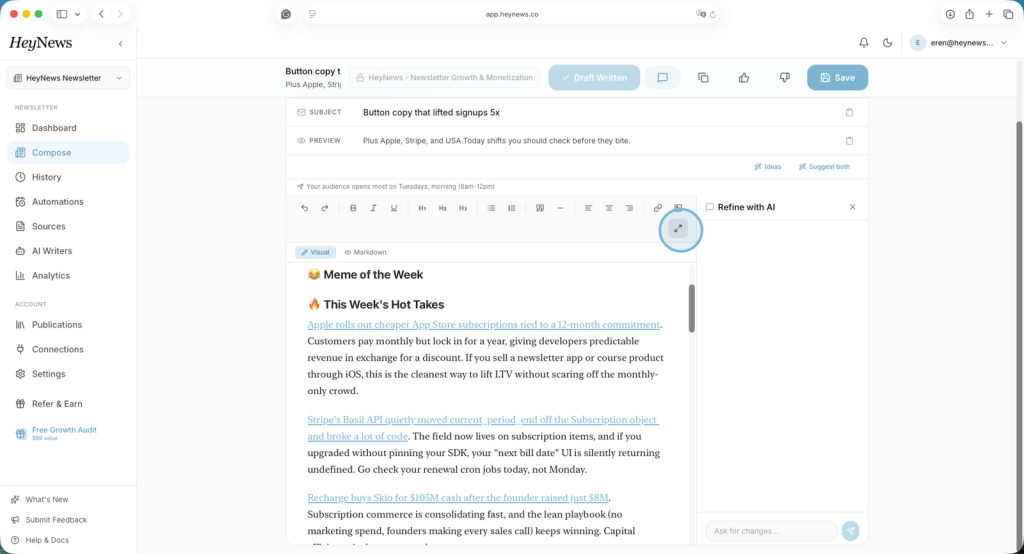
3. It generates a draft in your voice in one click. You select the stories you want to cover, pick an AI Writer, and HeyNews produces a full issue draft using your sentence patterns and section structure. From there, you can refine through chat (“make it shorter,” “punch up the intro,” “add a hot take on story three”) or use one-click transforms (shorten, expand, formalize, simplify, make more persuasive). When you are done, copy the issue into your email platform and send.
A few specifics that matter:
- Each newsletter you run gets its own AI Writer. If your Monday issue is a deep dive and your Friday issue is a link roundup, each gets its own writer trained on the right style.
- AI Writers learn from performance. If you connect beehiiv or Kit, HeyNews pulls open rates and click data after your issues have time to collect engagement, then uses those patterns to improve future drafts.
- You can run multiple publications from one account. Each gets its own AI Writers, sources, stories, settings, timezone, and language.
- Automations are available. Set a schedule per publication, and HeyNews creates the draft for you on cadence with fresh story guardrails (minimum stories, source filters, date windows). Drafts are never sent automatically. You always review before sending.
The full feature reference is in our knowledge base if you want to see all capabilities in one place.
How HeyNews Is Different from Generic AI Tools
This is the question we get most. The honest answer has two parts.
The first part is voice fidelity. Most general-purpose AI tools have never read your archive. The moment you open a fresh chat, the model produces the statistical average of every writer it was trained on. To get something close to your voice, you have to coach it through prompts every time. The voice you eventually coax out is also the voice the next session will forget. Memory features help at the margin. The underlying problem remains: the model does not actually know how to write until you teach it from scratch each time.
HeyNews ingests your archive on day one. Your AI Writer becomes a persistent object trained on the way you actually write. The next session starts where the last one ended. So does the session after that.
The voice you wrote into a chat tool last week is gone. The voice HeyNews learned from your archive is still there next Monday morning.
The second part is workflow. A general-purpose chat tool gives you an empty box. You bring the stories. You bring the structure. You bring the prompts. The tool does the writing. Everything else is still on you.
HeyNews is built around the full production loop. Sources are monitored on a schedule. Stories are scored on arrival. The compose view groups stories by source, lets you Smart Select the best ones with a button, runs the draft, suggests subject lines and preview text, and automatically saves drafts to History. The mechanical work moves off your plate. Your editorial judgment stays where it has always belonged.
Eren wrote about why voice fidelity is the actual product and what gets lost when AI tools relocate the work without removing it. Worth reading if you want the creative case alongside the technical one.
What Ships Today
Everything in the feature list above ships today. Specifically:
- Account and onboarding: Email or Google sign-in, magic links, guided onboarding wizard, dashboard with AI Writers, sources, stories, drafts, and recent issue performance in one view.
- AI Writers: Automatic voice learning from your connected newsletter, multiple writers per publication for different edition types, story count per section, performance-based learning when you connect beehiiv or Kit.
- Compose: Story selection by source with relevance scoring, Smart Select for one-click best story picking, full draft generation in your voice, AI chat refinement, one click transforms (shorten, expand, formalize, simplify, persuasive), hot takes generator, subject line and preview text suggestions, image search built into compose.
- Automations: Per publication schedules with weekly or biweekly cadence, advanced recurrence rules, fresh story guardrails, automatic Smart Select and draft creation, in-app and email notifications when drafts are ready.
- Sources and stories: RSS feeds with built-in feed discovery, followed sites, social profile tracking (X, LinkedIn, Instagram, TikTok, and others), newsletter platform imports from beehiiv and Kit, manual stories, and a browser extension for one-click article saving from any webpage.
- Analytics: Open rate, click-through rate, unsubscribe rate, and bounce rate in one dashboard. Flexible time ranges from 7 days to a full year. Best send time heatmap. Per issue breakdown. Recipient trend alerts when subscriber counts decline.
- Multi-publication support: Each publication keeps its own AI Writers, sources, stories, settings, language, time zone, and default send time. Quick switching from the sidebar. Archive and restore any publication.
- Integrations: beehiiv (API key), Kit (OAuth), Newsletter Archive for any platform with a public archive (no API key required), RSS feeds, and Chrome browser extension.
- Security: Encrypted connection tokens, read-only newsletter access (HeyNews never sends or edits in your platform), publication separation, your archive only trains your AI Writers.
What Is on the Roadmap
A few things we are actively working on, but did not want to gate the launch on:
- Direct platform connections for more newsletter platforms beyond beehiiv and Kit.
- Deeper performance learning loops, including per-section open and click attribution, where the platform supports it.
- Workflow improvements to the automations builder based on early user feedback.
- Public roadmap and feedback voting at roadmap.heynews.co, where you can see what we are building next and request what you want.
We will update the changelog every time we ship something material.
Pricing and Trial Mechanics
We have three plans, listed in full on the pricing page, and a launch promotion that runs through June 30.
Launch offer. Through June 30, your first 12 months are 50% off on any plan. The WELCOME50 promo code is applied automatically at checkout. Standard monthly rates resume after your first year ends.
The plans:
- Starter, $99 a month. $49.50 a month with WELCOME50 through June 30. 10 issues per month, 5 AI chat revisions per draft, 1 publication. Built for creators to validate a workflow.
- Pro, $299 a month. $149.50 a month with WELCOME50 through June 30. 30 issues per month, 20 AI chat revisions per draft, 2 publications. The best fit once you are publishing 20+ issues a month.
- Team, $499 a month. $249.50 a month with WELCOME50 through June 30. 60 issues per month, unlimited AI chat revisions, and 5 publications. Designed for content teams and agencies running multiple brands.
Add-ons are available if your usage outgrows your plan:
- Unlimited AI Revisions: $50 a month or $420 a year. Removes the revision cap from Starter or Pro.
- Issue packs: +10 issues a month at $99, +20 at $149, +30 at $199. Per-issue cost drops as pack size grows.
- Publication packs: +1 publication at $99 a month, +2 at $149, +5 at $229. Same volume logic.
Add-ons attach to any plan and stack when you need more room.
The 14-day free trial includes 5 drafts total, unlimited AI Writers, 5 AI chat revisions per draft, and 1 publication. You add a payment method to activate the trial. You can cancel anytime within the 14-day period at no charge.
When the trial ends, your account is paused until you subscribe. We stop checking your sources and disable the generation of new drafts. Your data stays. You pick up where you left off when you upgrade.
We do not have a free forever plan. Honest reason: this is a paid product priced for serious newsletter operators, and a free tier would change the kind of company we run. The trial is the right way to try it.
What to Do Next
If you run a newsletter and the production side has been eating more time than the writing, the trial is fourteen days, and you can connect your archive in under a minute.
Start your 14-day free trial ->
If you want to see what we are building before you sign up, the feature reference is the most complete public document. The changelog tracks weekly updates. The public roadmap shows what is coming and lets you vote.
If you have feedback about the product or this post, my email is in the footer. Eren reads everything that comes in. So do I.
Welcome to HeyNews.


