

The newsletter industry just posted its best year ever. According to beehiiv’s State of Newsletters 2026 report, publishers sent 28 billion emails in 2025, reaching more than 255 million unique readers. Open rates exceeded 41%. Paid newsletter subscriptions generated $19 million, a 138% increase over the prior year.
Those numbers tell a story of a booming medium. But they leave out the part that matters most to the people actually producing newsletters every week.
The production is crushing them.
I tracked my own newsletter production workflow for four weeks last year. Every task. Every minute. Source monitoring alone consumed 2.4 hours per issue. That means scanning RSS feeds, checking competitor newsletters, scrolling through X and LinkedIn for story leads, and cycling through the same 20 browser tabs every Monday morning. Multiply that by 52 issues per year and you arrive at 124 hours. That is three full work weeks spent on a single task that has nothing to do with writing.
Let that number sit for a second.

The industry is celebrating growth. Meanwhile, the people creating the content behind that growth are spending more time on production logistics than on the creative work their subscribers actually pay for. That gap between the industry’s success story and the individual creator’s lived experience is the trend nobody is talking about in 2026.
How Long Does It Take to Create a Newsletter?
The honest answer depends on how you define “create.” Most creators think of newsletter creation as writing. But writing is the smallest piece of the production workflow.
A typical weekly newsletter issue involves at least five distinct production stages: source monitoring and story discovery, story evaluation and selection, writing the actual draft, formatting and design, and distribution and scheduling. For a solo operator publishing weekly, the total time investment runs between 8 and 10 hours per issue. That adds up to 32 to 40 hours per month.
Here is the part that should concern you: writing accounts for roughly 20% of that total. The other 80% is operational work. Scanning sources. Evaluating stories. Formatting templates. Scheduling sends. Checking analytics from the last issue to inform the next one.
Nobody quits their newsletter because writing is too hard. They quit because everything around the writing takes too long.
The Litmus State of Email research found that in 2023, 51% of marketing teams needed two or more weeks to produce a single email campaign. That included copywriting, design, segmentation, and testing. By 2025, production timelines had improved significantly for marketing teams with dedicated resources and automation. But solo newsletter creators have not seen the same gains. They are still running the entire production chain alone, from research to send, with tools that were built for different workflows.
The most expensive part of your newsletter is the time you spend doing work a machine should be doing for you. Your ESP subscription barely registers by comparison.
What Is the Biggest Time Drain in Newsletter Creation?
Source monitoring. And it is not even close.
Source monitoring is the process of scanning your information ecosystem for stories worth covering. For most creators, this means opening a dozen or more websites, scrolling through RSS readers, checking social media feeds, scanning competitor newsletters, and evaluating whether each story is relevant enough to include.
This task feels like editorial judgment. You are deciding what matters, what your audience cares about, what fits the theme of this week’s issue. But the vast majority of the time spent on source monitoring is mechanical. You are scanning, not evaluating. You are loading pages, not making editorial decisions. The actual judgment, deciding which three or four stories make the cut, takes minutes. The scanning takes hours.
I estimated 2.4 hours per issue based on my own workflow. That number aligns with broader creator data. A 2025 study reported by Tubefilter found that 62% of creators experience burnout, with the production treadmill of research, write, format, send, repeat cited as the primary driver. The research stage is where creators spend the most unstructured time, because there is no clear endpoint. You stop scanning when you feel like you have found enough. Not because you have systematically evaluated your sources.
Source monitoring is janitorial work disguised as editorial judgment.
Not your fault. The tools were not built for this.
The Task Switching Tax Nobody Is Measuring
Here’s where the production bottleneck gets worse than the raw hours suggest.
Newsletter production forces you to switch between fundamentally different types of cognitive work. You go from scanning (low concentration, high volume) to evaluating (medium concentration, judgment based) to writing (high concentration, creative) to formatting (technical, detail oriented) to distributing (logistical, procedural). Each transition carries a measurable cost.
Gloria Mark, a researcher at the University of California, Irvine, has spent over two decades studying how knowledge workers handle interruptions and task switches. Her research found that it takes an average of 23 minutes and 15 seconds to fully regain focus after being interrupted or switching tasks. That is 23 minutes to return to the same depth of concentration you had before the switch.
Her research also found that workers switch between “working spheres” every 10 minutes and 29 seconds on average, and encounter an average of 2.3 intervening tasks before returning to the original one. In a published study on interrupted work, Mark documented that while 82% of interrupted work does get resumed the same day, the cognitive cost of those interruptions accumulates throughout the session.
Now apply this to newsletter production. A typical issue requires at least five to eight distinct task switches: from source scanning to story evaluation, from evaluation to outline, from outline to writing, from writing to image search (or creation), from image search back to writing, from writing to formatting, from formatting to scheduling. If each switch costs even 10 to 15 minutes of reduced concentration (a conservative estimate based on Mark’s findings), you are losing 50 to 120 minutes of productive capacity per issue to context switching alone.
That time doesn’t show up in your calendar. You do not have a block labeled “recovering from task switches.” But your brain is paying for it anyway, in slower writing, weaker editorial decisions, and the creeping exhaustion that makes you consider skipping this week’s issue entirely.
Your newsletter has a production problem, and you have been calling it a writing problem. Those are very different things.
The Modern Paradox: The Industry Is Growing While Creators Are Drowning
The numbers from beehiiv’s report tell a growth story. Publishers reached 255 million unique readers. Paid subscriptions more than doubled. The percentage of creators publishing daily tripled from 4.9% to 15.82% between 2023 and 2024. The medium is thriving by every external metric.
But growth without production efficiency creates a pressure cooker. More readers expect more consistency. Higher frequency demands more production capacity. Better monetization raises the stakes of every missed issue.
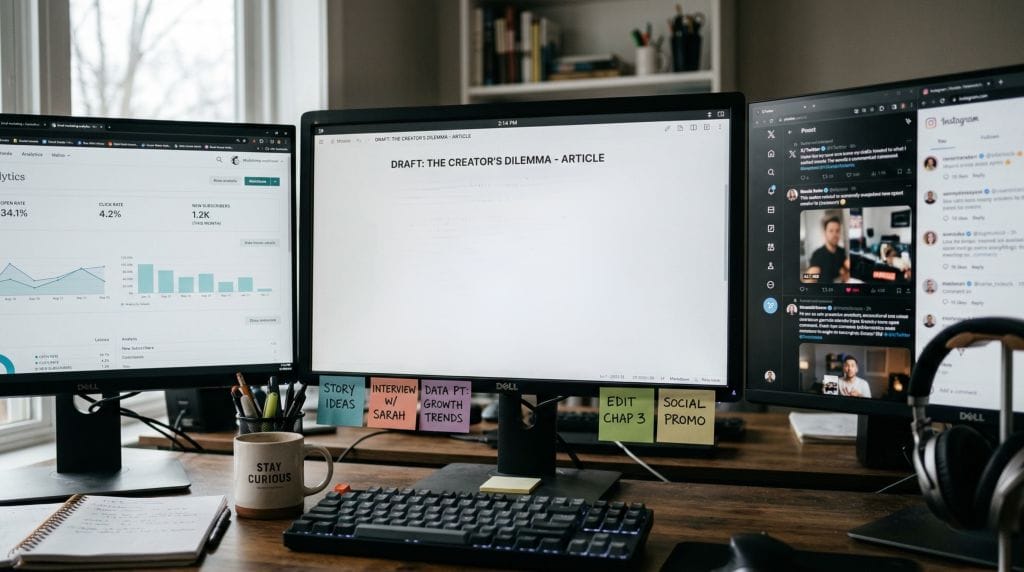
A ZDNet study cited by Passion.io found that 75% of content creators earning a full time income have experienced burnout. That number climbs to 83% among creators earning below average income. These are people whose production workflows are consuming more energy than the creative work itself.
Remember those 124 hours of source monitoring? Here’s where they actually go.
Across a typical year, a weekly newsletter operator might spend roughly 500 total hours on production. Of those, about 100 to 120 go to source monitoring and story discovery. Another 80 to 100 go to formatting, scheduling, and distribution logistics. Roughly 60 go to analytics review and performance evaluation. That leaves around 200 hours for actual writing, the work that drew the creator to newsletters in the first place.
Forty percent of the total. That is what writing gets. The remaining sixty percent goes to tasks that are necessary but mechanical, tasks that do not require the creator’s unique voice, perspective, or editorial instinct.
The newsletter industry’s biggest bottleneck nowadays is not audience growth. It is production sustainability. And the creators who solve it will be the ones still publishing in the future.
Can AI Actually Fix the Production Bottleneck?
The answer is yes, but only if the AI is solving the right problem.
Most AI writing tools focus on the 20% of newsletter production that is already the most human, the most personal, and the least in need of automation: the writing itself. They generate generic drafts from generic prompts, producing text that reads like it could have come from anyone. That forces the creator into a new task: editing a machine’s output until it sounds like them. The time savings are real but modest, because you have traded one form of labor (writing from scratch) for another (editing someone else’s voice into your own).
A landmark study by researchers at Harvard, MIT, and Wharton, conducted in collaboration with Boston Consulting Group, found that knowledge workers using AI completed 12.2% more tasks, finished them 25.1% faster, and produced results that were rated 40% higher in quality. But the study also revealed a critical caveat: for tasks outside AI’s capability frontier, workers using AI were 19% less likely to produce correct results. They stopped applying their own judgment because the AI output felt authoritative.
The takeaway for newsletter creators is precise. AI delivers enormous gains when applied to mechanical, high volume tasks where the creator’s unique judgment is not the bottleneck. Source monitoring. Story relevance scoring. Feed management. Format templating. These are exactly the tasks eating 60% of production time.
AI delivers diminishing or negative returns when applied to the core creative work. Writing voice. Editorial perspective. The specific way you translate complex ideas into language that your audience recognizes as yours.
Surprising? Only if you have been listening to the tools that want to replace your writing instead of the research that shows where replacement actually works.
HeyNews was built around this distinction. It connects to your newsletter platform (beehiiv via API key, Kit via OAuth, or any platform with a public archive URL), imports your past issues, and builds a voice profile by analyzing your tone, vocabulary, sentence patterns, section structure, and signature phrases. But the larger design principle is that the platform automates the 60% of production that is mechanical while preserving your control over the 40% that requires your voice.
The source intelligence engine monitors every site and feed you have historically referenced, scores incoming stories by relevance to your editorial patterns, and surfaces the stories that matter most. That is the 124 hours of source monitoring, automated. When you are ready to write, you select your stories, choose an AI Writer trained on your specific archive, and generate a draft that sounds like the next issue you would have written yourself. One click.
The 5 Minute Production Audit You Can Do This Week
You do not need to buy any tool to start fixing your production bottleneck. You need data about your own workflow first.
Here is a simple audit you can run on your next issue. Time every task to the minute and categorize it into one of five buckets.
Bucket 1: Source Monitoring. Every minute spent scanning feeds, checking websites, scrolling social platforms for story leads, and opening tabs.
Bucket 2: Story Evaluation. Every minute spent reading articles, deciding relevance, comparing stories against each other, and selecting your final lineup.
Bucket 3: Writing. Every minute spent drafting original text, writing commentary, composing introductions and transitions.
Bucket 4: Formatting and Design. Every minute spent on layout, image selection, template adjustment, link insertion, and visual consistency.
Bucket 5: Distribution and Admin. Every minute spent on scheduling, testing, sending, reviewing analytics from the previous issue, and managing subscriber lists.
After one issue, calculate the percentage of total time in each bucket. Most creators I have spoken with find that Buckets 1 and 2 combined account for 40 to 50% of the total. Bucket 3 accounts for 15 to 25%. Buckets 4 and 5 fill the rest.
If your writing time is below 25% of total production time, your workflow has a structural problem. And that problem will get worse, not better, as your audience grows and expects more consistency.
Your current production workflow is basically 20 browser tabs pretending to be a newsroom.
What the AI Adoption Data Actually Shows
The Validity State of Email 2025 report found that 70% of marketers predict up to half of their email operations will be AI driven by 2026. Another 18% expect AI to handle 50 to 75% of their email marketing tasks. The production time data backs this up: only 6% of teams now need more than two weeks to produce an email, compared to 62% just two years earlier.
But there is a gap between what marketing teams with dedicated resources can achieve and what solo newsletter operators experience. Marketing teams have designers, developers, copywriters, and project managers splitting the production load. A solo newsletter creator is all of those roles in one person, switching between them every few minutes, paying the cognitive tax on every transition.
The HubSpot and Selling Signals data on AI adoption among creators shows early but significant traction. Twenty eight percent of creators now use AI for brainstorming and 25% for content creation. Early adopters report reclaiming one to three hours weekly. And 64% of newsletter professionals surveyed believe newsletters will be entirely AI generated by 2030.
That last number deserves scrutiny. “Entirely AI generated” is a prediction that misunderstands what makes newsletters valuable. Readers subscribe for a specific human perspective, a voice they trust, a curatorial judgment they rely on. Fully automated newsletters would compete with RSS feeds, not with creator-led publications. The real opportunity in 2026 is not full automation. It is intelligent automation of the mechanical production layers that surround the creative core.
I mentioned craft earlier. This is what I mean. The goal is to spend more of your production time on the work that only you can do, and less on the work that a system can do faster and more consistently.
In a Nutshell
- Newsletter production for a weekly solo operator consumes 32 to 40 hours per month. Writing accounts for roughly 20% of that total. The remaining 80% is source monitoring, formatting, distribution, and admin.
- Source monitoring alone can consume 2 to 3 hours per issue, adding up to 100+ hours per year of mechanical scanning work.
- Task switching between production stages costs an additional 50 to 120 minutes per issue in lost concentration, based on Gloria Mark’s research showing a 23 minute recovery period after each context switch.
- AI delivers the strongest productivity gains when applied to mechanical production tasks (source monitoring, relevance scoring, format templating) rather than core creative work (writing voice, editorial perspective).
- You can diagnose your own production bottleneck this week: time your next issue across five buckets (source monitoring, story evaluation, writing, formatting, distribution) and calculate where your hours actually go.
The newsletter industry is growing faster than the workflows supporting it. That gap between what creators want to produce and what their production systems can sustain is the defining constraint of 2026. The operators who close that gap will keep publishing. The ones who do not will become part of the burnout statistic.

Your production time is finite. Spend it on the parts that actually need your brain.
Start your 14-day free trial. No credit card. No pitch calls. Just try it. → heynews.co


