

Last Sunday you spent six hours producing one issue. Scanning sources. Picking stories. Drafting. Formatting. Hitting send. The issue shipped. Good.
Let’s look into the part you did not log: In those same six hours, you skipped the sponsor who emailed you in March, the four readers who replied last week, and the referral flow you have meant to build since January. You ran the production. You skipped the revenue.
This is the blind spot inside almost every newsletter automation ROI calculation. Operators subtract a tool price from the revenue the newsletter earns and call that the return. The math misses the expensive part. Every production hour carries a second price tag: the money it could have earned somewhere else. You have read the first tag. You have almost never read the second.
Let me show you the number.
There is a reason the second tag stays invisible. Economists call it opportunity cost, the value of the best thing you gave up to do the thing you did. In 2009, a research team that included Yale’s Shane Frederick published a study in the Journal of Consumer Research showing that people routinely fail to weigh opportunity costs unless something forces the alternatives into view. The work found that naming the alternative changes the decision. When the alternative stays out of sight, the cost reads as zero.

Your production hours are the textbook case. The issue shipping is loud and visible. The sponsorship you did not pitch is silent. So the production hour feels free, and the work that would have grown the newsletter loses the competition for your week, every week.
Frederick and his coauthors found that people weigh what an hour could have earned elsewhere only when the alternative is spelled out for them. Left unspelled, the alternative drops out of the decision entirely.
That’s the diagnosis. Production and growth come out of the same finite weekly budget. Production has a deadline. Growth does not. So production wins the hours, and growth gets whatever is left. Most weeks, that’s nothing.
You can test the claim on yourself right now. Try to name, in dollars, what last Sunday’s production block could have earned if you had pointed it at growth. If the number does not come easily, that’s an opportunity cost of neglecting to work exactly as the research describes.
No judgment. The deadline made the call for you.
What Is the ROI of Automating Newsletter Production?
ROI is a simple ratio. Return minus cost, divided by cost. The standard guides for newsletter automation stop at one version of it: the revenue your newsletter already earns, minus the price of the tool.
That treatment has a hole in it. It assumes the hour you free up has no value until you spend it back on the newsletter. The opposite is true. A freed hour has a value the moment it exists, set by the best thing you could do with it.
So the real question is which column the hour lands in. Newsletter work splits into two kinds of hours, and they behave nothing alike.
The first kind is the sunk hour. Production. Source monitoring, formatting and the long tail of work after the draft. A sunk hour produces exactly one issue. Spend nine hours or spend three, the issue goes out once, to the list you already have. The output is capped no matter how much time you pour in.
Your production hour is a coin in a vending machine that only ever dispenses the same can.
The second kind is the compounding hour. Growth and monetization. An hour spent landing a sponsor, building a referral loop, or moving a free reader to paid keeps paying after the hour ends. It adds a subscriber, a deal, or a dollar that returns issue after issue.
The two hours look identical on your calendar. Sixty minutes each. The difference only shows up later, when one of them is still paying and the other one is a memory.
Automation moves an hour out of the column that never compounds and into the column that always does. That move is the entire return.
Surprising? Only if you have never run the second number.
How Do You Calculate Subscriber Lifetime Value?
To price a compounding hour, you need one figure: what a subscriber is worth to you across the whole time they stay. That figure is subscriber lifetime value, usually shortened to LTV.
The formula is plain. Take the profit one subscriber generates per month. Multiply it by the number of months they stay. The investor David Skok, who spent years studying subscription businesses at Matrix Partners, put the lifetime piece even more simply: average lifetime in months is one divided by your monthly churn rate. Churn is the share of subscribers who leave in a given month. A 2 percent monthly churn means an average lifetime of fifty months.
Run a quick example. The 2024 Substack Landscape Report, an analysis of 75,000 newsletters, found that the average paid subscription costs about $10 per month. At ten dollars a month across a 50-month lifetime, one paid subscriber is worth roughly five hundred dollars over their life on your list.
Most lists are free, and that is fine. The InboxReads State of Newsletters 2025 report found that 91 percent of the newsletters it tracked are free, while 77 percent are interested in sponsorships and ads. On a free list, a subscriber’s value comes from the ad and sponsorship revenue their attention supports. beehiiv reports that subscribers on finance and business lists can be worth thirty to a hundred dollars each per year through monetization.
Put that into the same formula. A free list subscriber worth fifty dollars a year, who stays three years, carries a lifetime value of a hundred and fifty dollars. The exact figure matters less than the habit of producing one. Once a subscriber has a number, every hour you might spend adding subscribers has a number too.
Whatever your model, the point holds. Every subscriber on your list already has a dollar value attached to them. The only optional part is whether you calculate it.
One more number turns LTV into a decision tool. Skok’s best known guideline is that a subscriber’s lifetime value should run at least three times what it costs to acquire them, a ratio the industry still treats as the line between healthy and underwater. At a five hundred dollar LTV, that means a new paid subscriber is worth spending up to about a hundred and sixty dollars to win. A freed hour that brings in even one of those has paid for a year of almost any tool you could buy.
Where a Reclaimed Hour Actually Earns Its Return
And now, the part that the cost calculators never reach. A production hour and a growth hour payout on completely different schedules.
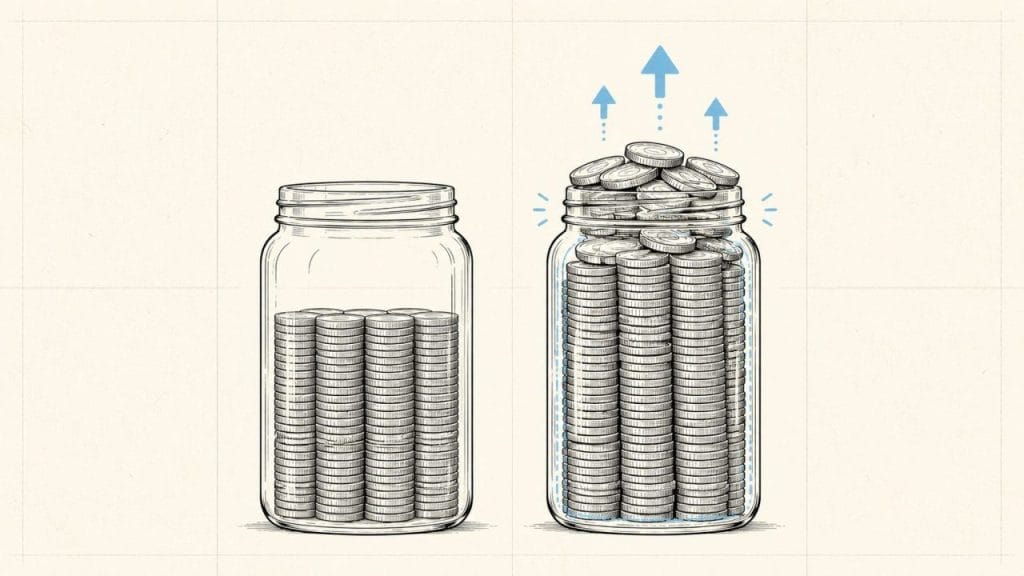
A production hour pays once. You spend it, the issue ships, the payment is over. I priced what that single payment costs you in an earlier post on the real cost per issue of a DIY newsletter. This is the other half of the ledger.
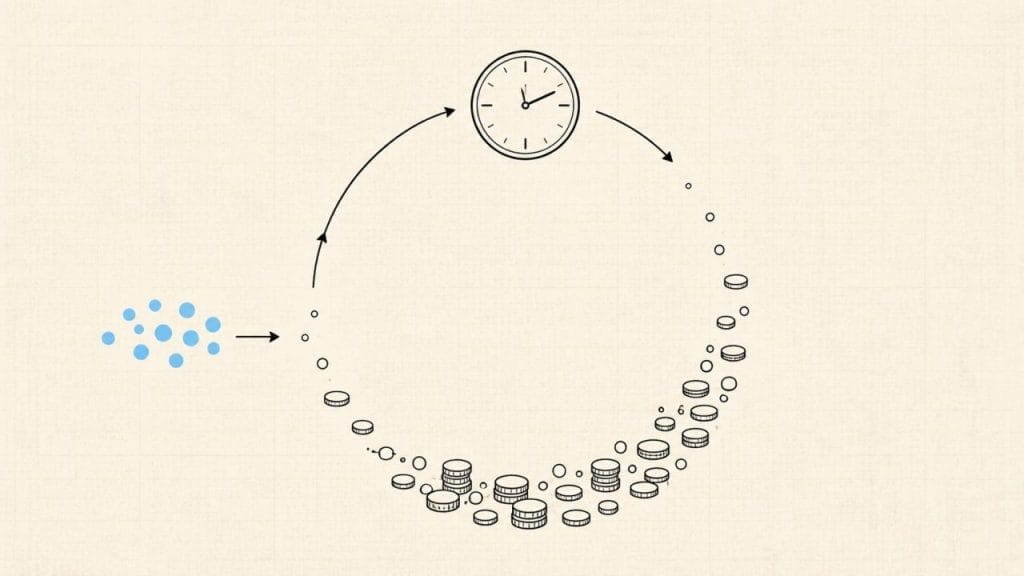
A growth hour pays on a loop. Spend an hour setting up a referral mechanism and the subscribers it brings keep generating LTV every week they stay. Spend an hour landing a recurring sponsor and the placement pays across every issue in the contract. The hour ends. The return keeps arriving.
A production hour pays you once. A growth hour pays you every week the subscriber stays. The gap between those two is the financial case for automation, measured in weeks.
This is what time to money actually means for a newsletter. The speed at which a freed hour turns into recurring revenue depends entirely on which lever you point it at. The cheapest levers are usually the ones operators have no time to pull. Industry data reports that a referral brings in a subscriber for around 17 cents, against one to three dollars through other channels. Referrals stay cheap because your existing readers do the work, and the work only happens if you have an hour to set the loop up in the first place.
17 cents. Let that number sit, then look at where last Sunday’s hours actually went.
Picture the two hours side by side. Hour one goes to reformatting a draft that ships tonight and earns nothing beyond the issue it produced. Hour two goes to a partnership swap with another newsletter in your niche, which sends you forty new subscribers who keep opening for years. By the standard cost calculator, both hours cost the same. By the LTV math, one returned nothing and the other returned forty subscribers times your lifetime value.
For paid lists, the lever is conversion. Community analysis of Substack data suggests most lists convert free readers to paid at around 3 percent, below the 5 to 10 percent Substack cites as a benchmark. Even at 3 percent, an hour spent improving the upgrade path compounds, because each new paid reader carries the full LTV you just calculated. The conversion rate is a number you can move. You move it with the hours you currently do not have.
Is It Worth Paying to Automate a Newsletter?
Now put the tool cost back in. This is where the standard guides started, and it is the smallest variable in the whole model.
Take HeyNews as the example I know best, because we built it. It connects to your newsletter platform through the beehiiv API or Kit’s secure login, or through any public archive URL for Substack, Ghost, Mailchimp, ActiveCampaign, or Medium. It reads your past issues, learns your voice, monitors the sources you already reference, scores incoming stories for relevance, and closes the analytics loop on its own by pulling open and click data after each send. The mechanical layer that eats your Sunday runs in the background.
The live plans start at $19.5 a month at the entry tier and increase with publishing volume (after the 50 percent launch discount is applied, it’s only valid through June 30). The number that matters for the model is smaller than any plan price. Spread across a month of weekly issues, the software costs a few dollars per issue.
Set that against the LTV math. If a freed hour helps you add one paid subscriber worth five hundred dollars over their lifetime, or land one recurring sponsorship, the tool returns its annual cost in a single afternoon. The tool price is the only number in this calculation small enough to ignore. The hour it frees is the one worth your attention.
Surprising that the tool price gets all the debate while the freed hour gets none? Only until you have priced the hour.
The Return on Reclaimed Time Model You Can Run This Week
You do not need a tool to run the financial case. You need four numbers and fifteen minutes. Call it the Return on Reclaimed Time model.
Step 1: Find your LTV per subscriber. For a paid list, multiply the monthly profit per subscriber by your average subscriber lifetime, which is one divided by your monthly churn. For a free list, divide your annual sponsorship and ad revenue by your subscriber count. Write the number down.
Step 2: Estimate subscribers added per growth hour. Be conservative. If one focused hour on referrals or partnerships realistically adds two subscribers, use two. Honesty here matters more than optimism.
Step 3: Multiply. Subscribers added per hour times LTV per subscriber equals the return on one reclaimed hour. Two subscribers at $100 LTV is $200 per hour of growth work.
Step 4: Compare. Take the monthly cost of whatever would automate an hour of your production, divide it across your issues, and set it next to the per-hour return from Step 3. The gap is your answer, in dollars, specific to your publication.
Two examples to anchor it. A paid operator with a $500 LTV who adds one paid subscriber during a focused growth hour just produced $500 in return from that hour. A free operator with a $50 annual value per subscriber, who adds 20 subscribers in a growth hour, produces $ 1,000 in lifetime value. Set either against a tool that costs a few dollars per issue, and the comparison stops being close.
Most operators who run this land in the same place. The return on a reclaimed hour beats the cost of reclaiming it by a wide margin, and those hours have been going to the one kind of work that never compounds. You are not alone in finding that. Every operator we have walked through the model arrives at the same number with a slightly stunned look.
In a Nutshell
- Newsletter automation ROI has two variables: the tool cost and the value of the hour it frees. Almost everyone measures the first and ignores the second.
- Your production hours are sunk. They produce one issue, whether you spend three hours or nine. Your growth hours compound, because they add subscribers and deals that keep paying.
- Subscriber lifetime value is the number that prices a freed hour. It is the monthly profit per subscriber times the average lifetime, where lifetime is one divided by the monthly churn.
- You can run the Return on Reclaimed Time model this week with four numbers and no tool: your LTV, subscribers added per growth hour, the product of the two, and the per-issue cost of automating an hour.
- The financial case for automation lives in one move: shifting your scarcest hours onto the work that compounds.
What This Changes
Go back to last Sunday. Six hours on production. Zero on the sponsor, the replies, the referral loop. The issue shipped, and the second price tag went unread, the way it does every week.
Here is what to do next. Calculate one number: your LTV per subscriber. Then, time one issue and mark which minutes went to production and which went to growth. Put the two figures side by side. For most operators, that single comparison reframes every tool decision that follows, because for the first time, the freed hour has a price.
The newsletters still publishing in five years will be the ones whose operators learned to spend their hours on the work that compounds. The medium keeps growing. The hour stays finite. That tension is the whole game.
See what editorial intelligence looks like when the mechanical layer runs itself. The 14-day trial gives you five drafts to test against your own archive, a payment method starts it, and the 50 percent launch discount holds through June 30: heynews.co


